

01 Operate · Hub · Run live sites
Run live data centers
Data center operations is where a facility earns its uptime. These are the four roles that keep the floor running: technician, NOC operator, critical facilities and network & cabling. What each one does, who it suits, and how to prepare with the method interviewers reward.
Data Center Interview Question Bank: $49, one-time. 30-day refund, no reason needed, you keep the files.
Explore the facility · 5 systems
The building you'll run
Power chain
Utility to ATS to UPS to PDU to rack: the chain every outage question walks.
Who works on this
Critical Facilities · Technician · MEP Design · Commissioning
Learn it
Cooling & airflow
Hot and cold aisles, and why containment is the first cooling answer.
Who works on this
Critical Facilities · Technician · MEP Design · QA/QC Quality · Controls / BMS
Learn it
Servers & racks
Rack elevations, U-space, and the hands-on work at the rack face.
Who works on this
Learn it
Network fabric
Leaf and spine: every rack two hops from every other rack.
Who works on this
NOC Operator · Network & Cabling
Learn it
Structured cabling
Overhead tray, labeled runs, and the documentation discipline behind them.
Who works on this
Learn it
Where you are on the Operate path
Start with the interview gate. Climb as your role deepens.
- ENTRY
Interview Question Bank
USD $49Practice the real interview, aloud. 232 questions, 4 role tracks.
View this rung - UNDERSTAND
Data Center Fundamentals
USD $69See how power, cooling, hardware and networking depend on one another.
View this rung - REHEARSE
Shift Simulation Lab
USD $49Run real shifts: tickets, incidents, handovers, under time.
View this rung - THE WHOLE ROUTE
The System
USD $149The Question Bank, Data Center Fundamentals, the CV, LinkedIn & Evidence Kit and Get Hired (employer targeting, the 30-day application sprint, salary bands and offer negotiation, and your first 90 days on site) in one purchase, in order.
View this rung - THE WHOLE LADDER
Complete Career Library
USD $399 Save $290All 11 products across all three paths, in one purchase.
View this rung
Where to start: the 25 free questions, then the Data Center Interview Question Bank as the core paid step, then Data Center Fundamentals for the systems underneath it. Each rung builds on the one before.
Aiming beyond operations? The Engineer path covers design, commissioning and controls. Preview the Engineer path
Four operations roles
The tracks that run the floor
Data Center Technician
Data center technicians do the hands-on work on the floor: racking and stacking servers, running and dressing cables, swapping failed hardware, and acting as remote hands for teams that can't be on site.
Explore this pathNOC Operator
NOC (Network Operations Center) operators are the eyes of the site. They watch dashboards and alerts, triage what matters, open and drive incidents, and coordinate the right people to respond, often across multiple facilities at once.
Explore this pathCritical Facilities Technician
Critical facilities technicians keep the physical environment running: utility feeds, UPS and batteries, generators, switchgear, and the cooling systems that stop equipment from overheating. When these fail, the whole site is at risk.
Explore this pathNetwork & Cabling Technician
Network and cabling technicians build and maintain the physical layer: structured copper and fiber, patch panels, cross-connects, and the labeling and documentation that keep thousands of connections traceable.
Explore this pathStarting any of these tracks with no data center credential yet? The free Data Center Certified Associate (DCCA) is a common first one on entry-level CVs: what its coursework and exam involve. Comparing beyond operations? All 13 roles.
Building or commissioning instead? See the Build path and the Engineer path.
Orient · certification map
Not sure which certification comes first?
The Certification & Vendor-Course Navigator maps which credential fits your operations role, what each is worth, the order to take them in, and the free vendor courses to complete before you pay for anything.
Free PDF · Operate hub
25 interview questions, with what the interviewer is really checking
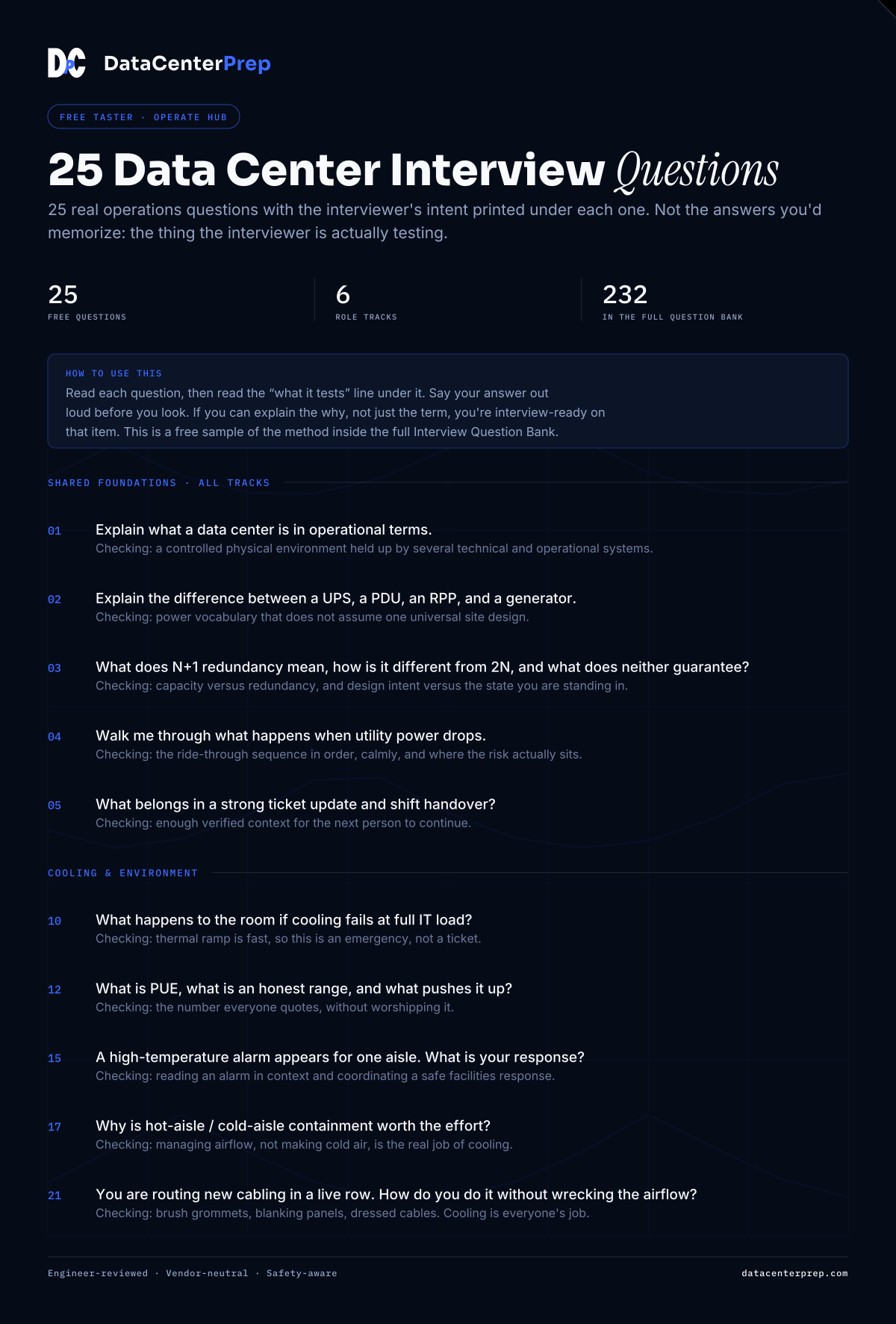
Prepare for your operations interview
Go straight to the full Question Bank for your track, or start with the 25 free role-tagged questions first. Data Center Interview Question Bank: $49, one-time. 30-day refund, no reason needed, you keep the files.
End of aisle: 01 Operate
Next aisle: 02 Build