

The System
Secure payment · Instant download · 30-day refund, no reason needed, you keep the files
You go from not knowing the systems to answering, in order, the questions a data center interview actually asks. The System is four complete products on one route: the 232-question Interview Question Bank, the ten-module Data Center Fundamentals course, the CV, LinkedIn and Evidence Kit, and Get Hired, for targeting employers and negotiating the offer. 1,106 pages, $149, one-time, 30-day refund.
USD
$149
files
126
pages
1,106
refund
30-DAY
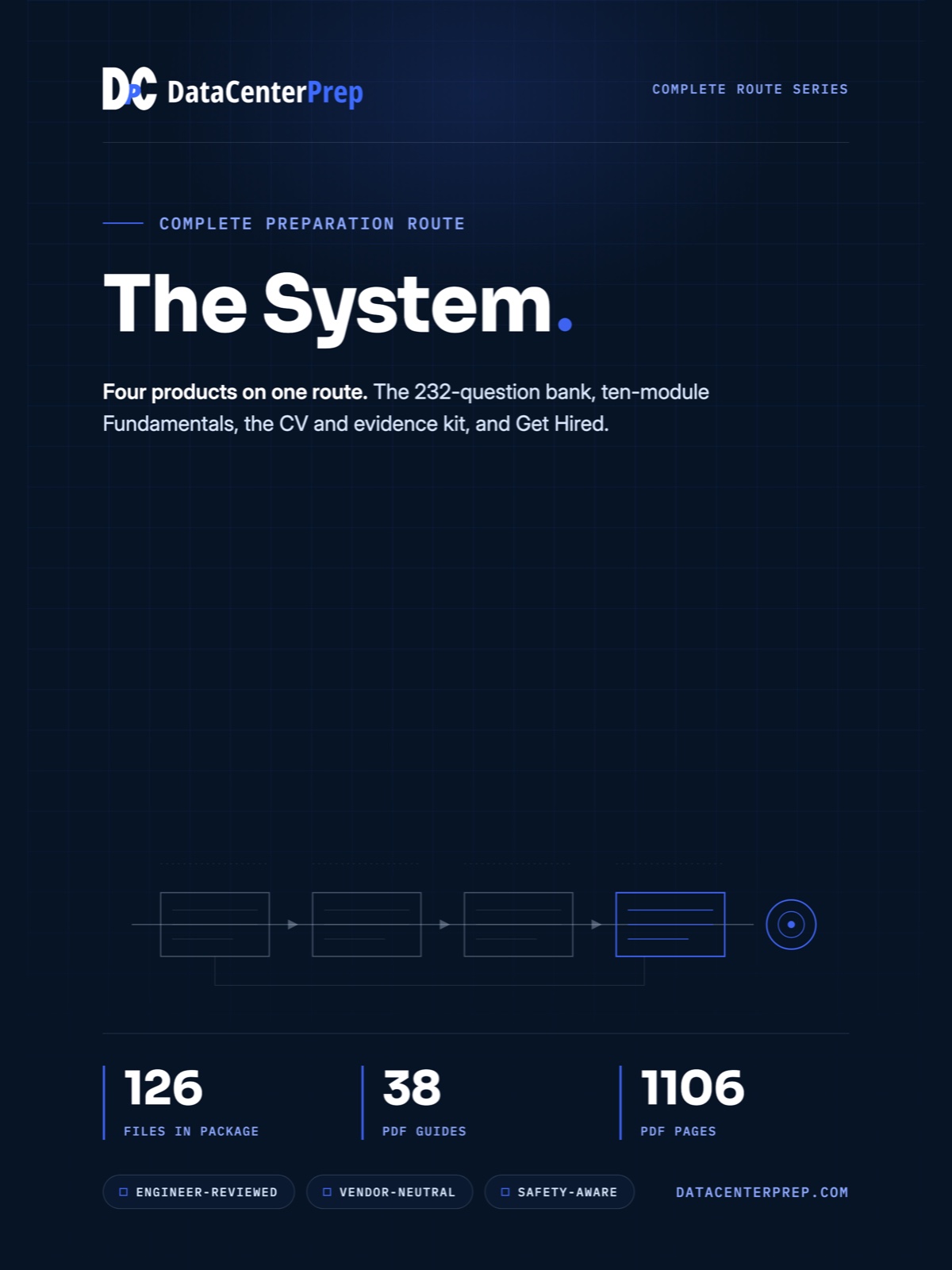
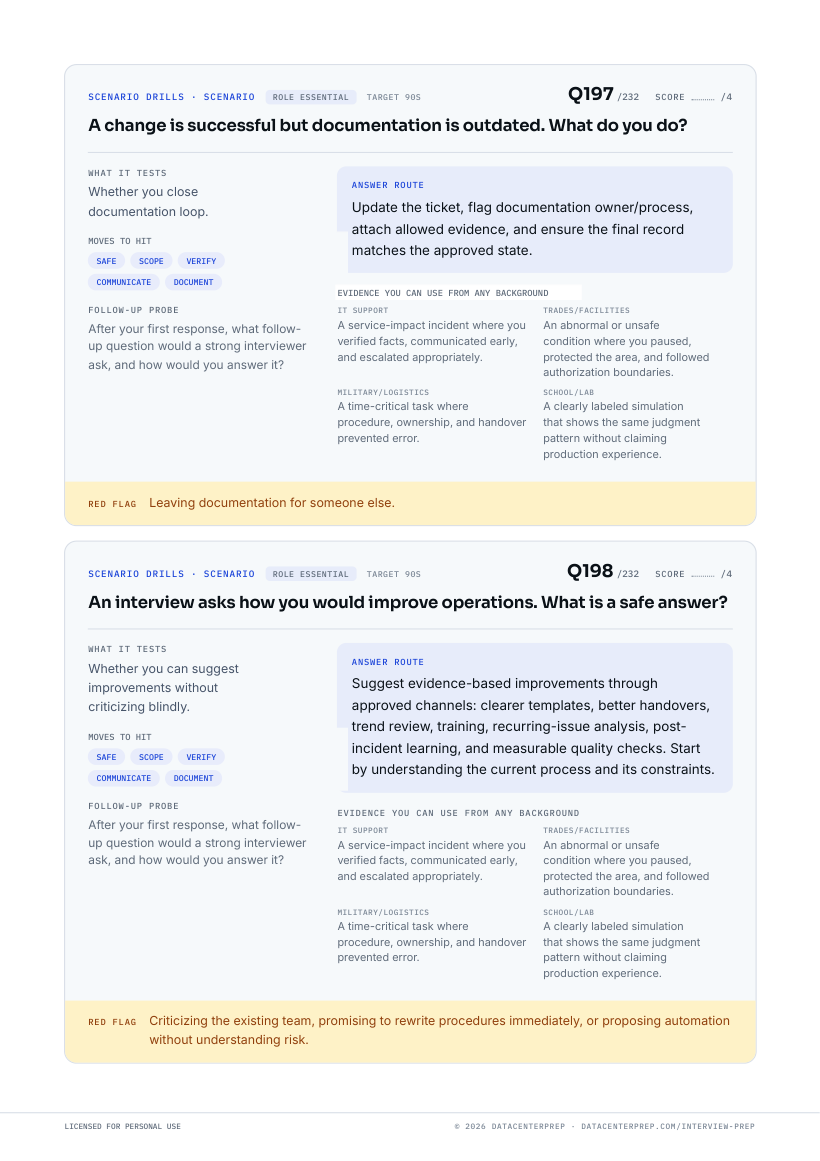
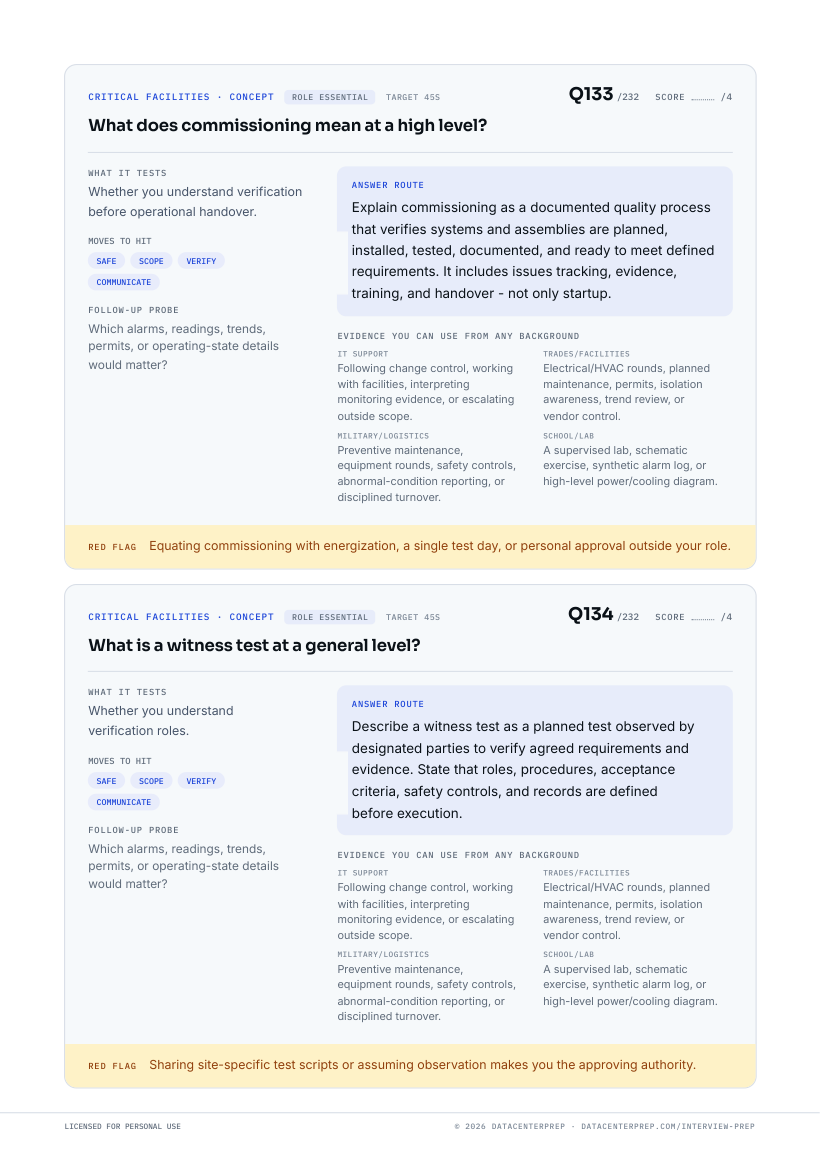
2 real pages from the download. Open any page full size.
Includes Get Hired, which is not sold separately
Before you buy
- Is this real material?
- Yes. 1,106 pages, Engineer-reviewed. The preview pages further down are real pages from this download, so you can judge the writing and the depth before you spend anything. See the real pages
- What if it's not for me?
- One email inside 30 days refunds it, no reason needed. You keep the files. The refund is the test every claim on this page has to survive.
- Will it fit my role?
- For anyone preparing seriously for a data center role who wants one route rather than four decisions: career changers, candidates new to the sector, and technicians stepping up.
Updates are included for 12 months: request a fresh link from your account page any time and it carries the current edition of every file, no extra charge.
One ZIP file, about 42 MB. Inside: 126 files · 1,106 PDF pages · 5 editable DOCX · 3 tracker XLSX.
Reviewed by a commissioning lead with 12 years on live sites.
01 · What's inside
What the route does for you
- One ordered route instead of four separate purchases: understand the systems, answer the questions out loud, put the evidence on paper, then run the search and the offer conversation.
- All 232 role-tagged questions across the four role tracks plus foundations, scenario drills and modern infrastructure, scored against the published six-dimension rubric so you can tell a good answer from a fluent one.
- The ten-module Fundamentals course covering the power, cooling, racks, resilience, monitoring and safety that every interview assumes you already understand.
- The parts almost nobody sells you: how to target the right employers, what the bands actually pay, how to answer the follow-up, and what to do in the first ninety days so the job sticks.
In this package
- Data Center Interview Question Bank: 232 role-tagged questions with answer frameworks, red flags and 24 worked model answers
- Data Center Fundamentals: ten modules on the systems underneath the questions, with labs, review cards and the mastery tracker
- CV, LinkedIn & Evidence Kit: editable CV and LinkedIn templates, four finished examples, and the application tracker
- Get Hired: employer targeting, the 30-day application sprint, salary bands and offer negotiation, follow-up, and your first 90 days on site
Includes Get Hired, which is not sold separately
Preview 3 pages
A public preview of pages from the products inside, so you can see the depth and format before you buy.
The DCP Answer Model
Eight moves that hold up under pressure
6 MIN · THE FRAMEWORK BEHIND ALL 232 ANSWER ROUTES
Read the transcript
Welcome to the Interview Question Bank anchor lesson. You will learn how to answer an unfamiliar data center scenario without guessing, overclaiming authority, or reciting a memorized script. The goal is a clear response that shows safety, scope, evidence, judgment, communication, and closeout. Keep a blank page nearby. You will build one answer before this lesson ends. Consider this question: a rack loses power during a night shift. What do you
do first? A weak candidate rushes to a technical fix. A strong candidate notices that the interviewer is testing behavior under uncertainty. Do you confirm whether the impact is one device, one rack, or wider? Do you protect safety and service? Do you use alarms, tickets, recent changes, and permitted observations? And do you know where your authority ends? Six hiring signals sit underneath the question. First, safety: you do not
improvise around energized or protected systems. Second, scope: you identify what is and is not affected. Third, evidence: you distinguish confirmed facts from assumptions. Fourth, boundaries: you understand that physical access is not permission to act. Fifth, communication: you can give the next team a useful payload. Sixth, closeout: you validate the current state, document decisions, and make ownership explicit.
The Question Bank uses an eight-part answer architecture. Scope the question. State the safety and authorization boundary. Verify facts and impact. Choose only a controlled, approved action. Communicate and escalate. Document clearly. Confirm the current state. Then reflect and improve. You do not need to announce all eight labels in an interview. Use them as an internal checklist so the answer has a beginning, a controlled middle, and a complete
ending. Here is the method in speaking order. Scope the condition. Protect safety and service. Verify evidence. Name the approved procedure or runbook. Communicate the verified state. Escalate when risk, impact, time, or technical scope exceeds your role. Document timestamps, evidence, decisions, and results. Finish with handover or closure. In natural speech, some steps combine.
What matters is that you do not skip the boundary, the evidence, or the closeout. For the rack power scenario, begin by confirming the reported scope, time, related alarms, incident record, and recent work. State that you would not reset protection, operate breakers, or move power connections merely to test a theory. Follow the approved first-response route and contact the accountable facilities, monitoring, network, or service owner. Then document
what is known, what remains unknown, who owns the next action, and when the next update is due. Listen to the difference. The weak answer says, I would reset the P D U, it is probably a failed feed, or I would try another outlet. Each statement turns an assumption into action. The stronger answer says, I would confirm scope and evidence first. Cause remains unconfirmed until evidence supports it. Any physical
action follows authorization and the approved procedure. This sounds less dramatic, but it demonstrates the reliability mindset employers need. A concise answer can sound like this. First, I would protect safety and confirm the scope rather than assume the cause. I would check the incident record, approved monitoring, related alarms, recent changes, and permitted observations. I would stay within my authorization, follow the runbook, and escalate with the
confirmed impact, evidence, actions already taken, and help required. After an authorized recovery, I would validate the current state, document the outcome and remaining risk, and provide a clear handover. Use the workbook rubric. Zero means unsafe, absent, or invented. One is relevant but vague. Two has a working structure but misses evidence or closeout. Three is interview-ready and role-appropriate. Four adds a concise,
truthful example, a result, a lesson, and precise boundaries. Do not chase a four by adding jargon. Improve the answer by removing assumptions and adding evidence you can defend. Pause after this slide and complete one attempt. Choose a Foundations question or a question from your primary role track. Speak for sixty to ninety seconds without reading. Score the response from zero to four. Remove one unsupported assumption
or unauthorized action. Add one truthful evidence sentence from work, training, a project, or another controlled environment. Then repeat. If you own the matching product, record the attempt in the Interview Practice Workbook. The key lesson is simple: scope before cause, evidence before action, authority before intervention, and validation before closure. That structure lets you answer unfamiliar questions with credible confidence. Continue with the Question
Bank, the worked response, and the Practice Workbook.
This framework carries every answer route in the Question Bank.
-
1. Safe
Check hazards, access, energy, and authorization first.
-
2. Scope
Confirm the asset, area, service, and real impact.
-
3. Verify
Read alarms, tickets, labels, trends, and the runbook.
-
4. Act
Follow the approved response; stop if assumptions break.
-
5. Communicate
State facts, impact, owner, action, and next update.
-
6. Escalate
Hand off when risk, scope, or skill exceeds your role.
-
7. Document
Record time, checks, actions, evidence, and exceptions.
-
8. Handover
Confirm owner, residual risk, next action, and deadline.
Who it's for
For anyone preparing seriously for a data center role who wants one route rather than four decisions: career changers, candidates new to the sector, and technicians stepping up.
Not for candidates who only need one piece. If you want the questions alone, the Question Bank stands alone at $49; if you only need the systems, Fundamentals stands alone at $69.
03 · How to use it
A clear way to work through it
Work it in order. Fundamentals until the systems make sense, then your role track in the Question Bank until you can answer out loud, then the CV kit once you have evidence worth writing down, then Get Hired when you start applying.
What this path pays
- Data Center Technician (mid)
- $65,000–$78,000
- Senior / Lead Technician
- $75,000–$110,000
Typical US ranges; total compensation varies by market, shift, and employer. Sources and dates shown.
Source: 2026 industry salary guides · as of 2026-08
What the classroom route costs
A single instructor-led data center course typically runs $1,500 to $2,500. This is the self-study route: $149, one-time.
What the certifications cost →05 · Questions
Questions about The System
My interview is a video call or a phone screen. Does this still work?
Yes. Phone screens, video rounds and onsite loops all score the same skill: structured spoken answers. You practice out loud and score yourself 0 to 4, and the answer holds on a phone screen, on a video call, or on site.
How is this different from buying the pieces separately?
The Question Bank and Fundamentals alone are $118 bought separately, and the CV kit is another $39. The System is $149 for all of that plus Get Hired, which is not sold on its own at all, and it puts them in an order that tells you what to do next.
What is Get Hired, and can I buy it separately?
It is the part after the interview technique: employer targeting, a 30-day application sprint, salary bands and offer negotiation, follow-up, and the first 90 days on site. It is not sold on its own: it ships inside The System and inside the Complete Career Library.
I already own the Question Bank or Fundamentals. What is the fair route?
Already own one of the pieces? Any purchase in the last 30 days counts toward the Complete Career Library. For this bundle, email info@datacenterprep.com with your order reference before you buy and we tell you the fair route; a real person answers.
Is this a video course?
It is 1,106 pages of written material across 126 files, including editable templates, trackers and flashcard imports. The sequence is the product: everything works offline, and you can print any of it and take it into the interview.
Questions before you buy? Email info@datacenterprep.com
Get The System
$149 · instant download after payment
Pay securely by card. Your download link is shown on the confirmation page and sent in your delivery email (subject: Your download of The System is ready). Every product carries a 30-day refund, no reason needed, you keep the files.
Your download is one ZIP. Unzip it, then open the OPEN_THIS_FIRST page first. On a phone, tap the ZIP in your files app to extract it.
30-day refund, no reason needed, you keep the files. The policy.
Personal-use license: yours to keep and print; not for resale or redistribution. Training a team? Ask about an organizational license.
Updates are included for 12 months: request a fresh link from your account page any time and it carries the current edition of every file, no extra charge.
One ZIP file, about 42 MB. Inside the download: 126 files · 1,106 PDF pages · 5 editable DOCX · 3 tracker XLSX. Derived from the shipped package.
Reviewed by a commissioning lead, 12 years on live sites. How we review.
Scope note
DataCenterPrep materials are for education and interview preparation. Scenario answers are generalized and are not live operating procedures. Always follow employer procedures, authorized training, and local requirements.
Last reviewed: July 2026 · DataCenterPrep engineer review.
$149, one-time, 30-day refund
Instant download after payment; 30-day refund, no reason needed, you keep the files. This one is a route of its own: the Complete Career Library ($399) carries the individual products instead.
Part of the Operate path: see every role and product on that path, or the full role directory.